I've heard it. You've heard it. Social Security is going broke. This is not breaking news by any means. I have clients well into their retirement years who were told as young adults they would never receive Social Security. Guess what? They're receiving Social Security.
Are things more dire now?
The 2026 Trustees Report shows that the Social Security Retirement Trust fund will be depleted in the 4th quarter of 2032, which would trigger an automatic ~22% benefit cut without Congressional action. This is one quarter earlier than reported in last year's report.
The 2026 report lists some items that would extend solvency of the trust fund through the year 2100. These are:
Any single one of these items on their own would extend Social Security's solvency through 2100, but of course none of them would be terribly popular to those who have to bear the cost.
Importantly, the Trustee's Report states:
"If substantial actions are deferred until the OASDI (Old age, Survivors, and Disability Insurance) reaches depletion, significantly larger changes would be concentrated on fewer years and fewer generations".
Government's kicking of the can on Social Security's issues has greatly increased the costs for those who will eventually foot the bill. This has been a bipartisan failure many decades in the making. Not only is neither political party addressing the issue, they seem focused on making it worse. In recent years we have seen both sides of the aisle pass legislation that sped up the projected insolvency of Social Security:
Let's look at why Social Security has this shortfall, what can be done about it, address a few myths, and how you should plan your finances accordingly.
Ironically, the problems with Social Security were apparent rather quickly as the first ever Social Security recipient, Ida May Fuller, paid in a grand total of $24.75 of Social Security taxes (from 1937 - 1939) and started receiving $22.54 PER MONTH in January of 1940. She lived to be 100 (of course) and collected a cumulative total of $22,888 in Social Security benefits which is nearly 925 times what she contributed. That's a return on investment that would make Bernie Madoff proud.
There are myths on the internet that Social Security's original filing age was 65 because the life expectancy in 1935 was 58 for men and 62 for women, so it was designed so no one could collect. That is not true.
Life expectancy at birth in that era was dragged down heavily by infant and childhood mortality. Of Americans who survived until age 21 at the time, more than half would reach age 65.
The Committee on Economic Security didn't pick 65 by guessing how long people would live. They used a precedent set by existing state pension plans and the federal Railroad Retirement System which was passed a year earlier. Robert J. Myers, an actuary on Roosevelt's committee, wrote in his 1992 memoir that "65 was chosen because 60 seemed too young and 70 seemed too old". That doesn't seem like great actuarial work.
However, it is true that life expectancy has grown since 1935. A man who reached age 65 in 1940 could expect to live about 12.7 more years, while a man who reaches 65 today is expected to live about 19 more years.
The Social Security mortality projections have overstated and understated gains in life expectancy during different periods. While life expectancy has played a role in Social Security's projected shortfall, a Congressional Research Service brief published earlier this year found that the primary driver is a shift in the population's age distribution due to lower birth rates.
At the end of the baby boom era in 1960, the U.S. Total Fertility rate stood around 3.6 children per woman. Today it is around 1.8.
Social Security is a "pay-as-you-go" system, meaning today's payroll taxes from today's workers fund today's checks to today's beneficiaries. The ratio of workers paying in to beneficiaries drawing out is the most important factor on the program's financial well being.
In 1960 there were 5.1 workers paying in for every 1 person that was collecting. As of 2024 it was estimated there were only 2.7 workers paying in for every person collecting.
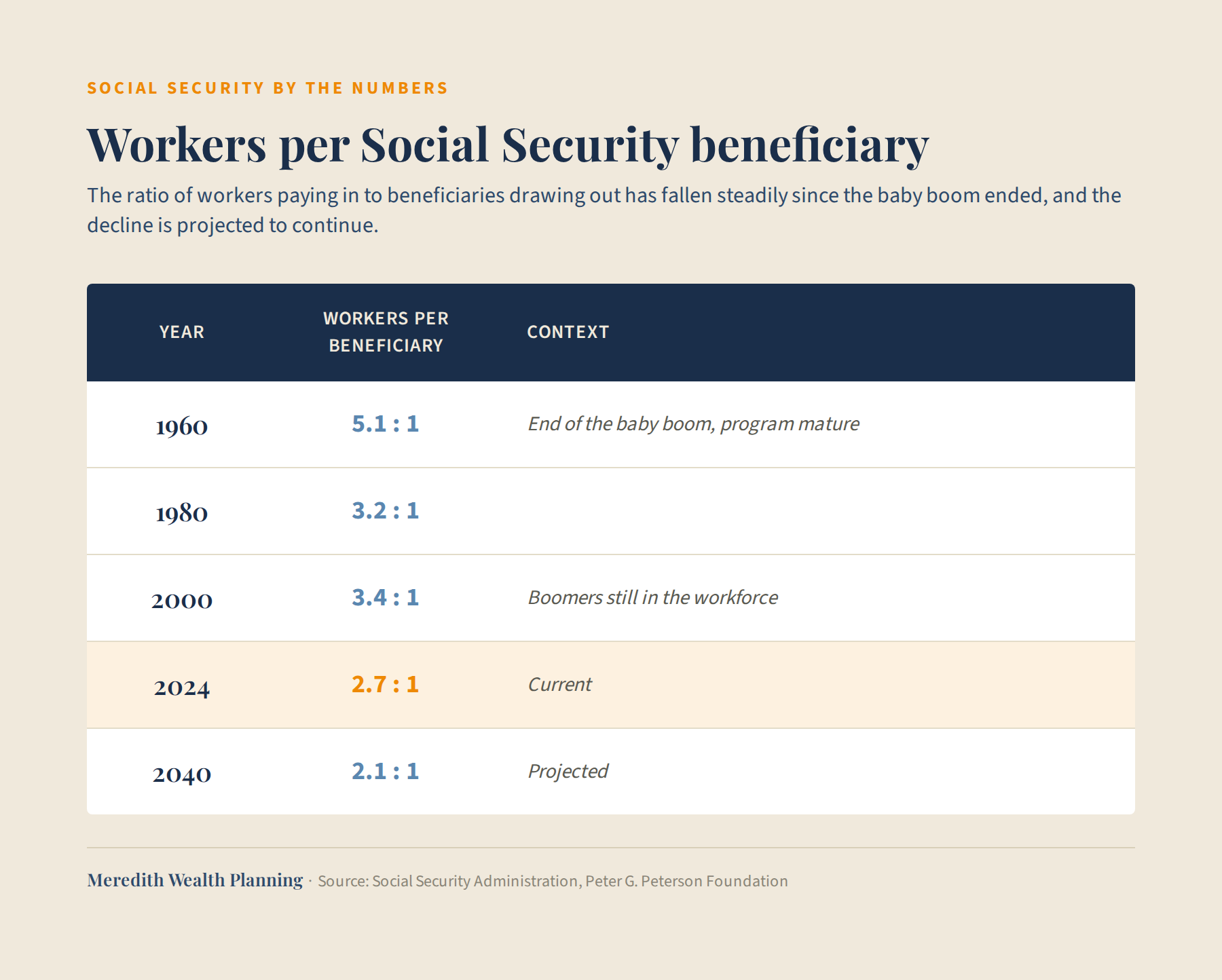
A combination of people living longer and a declining birth rates has wreaked havoc on Social Security.
No I am not talking about Coke Zero. I am talking about Cost of Living Adjustments to Social Security benefits, which ideally helps retirees keep up with inflation.
Before 1972 there was no automatic COLA to Social Security. Benefit increases were entirely discretionary and Congress legislated them periodically, but they were irregular and often timed around elections (imagine that!). There was no mechanism tying benefits to inflation.
In the early 1970s, legislators went bananas with COLAs. Benefits were increased 15% in 1970, 10% in 1971, and 20% in 1972. That is a cumulative 51.8% in 3 years (inflation was a cumulative 13% during the same time period)! They also added automatic adjustments based on price growth, to hopefully curtail the potential for politics to play a role in ad hoc benefit adjustments.
This worked as intended for people already receiving checks, but that same formula was mistakenly used to calculate the initial benefit for anyone who hadn't retired yet, applied to their fixed, historical earnings. In the stagflation of the 1970s, prices rose faster than real wages which threatened to let some future retirees collect benefits that exceeded what they'd actually earned while working. Congress fixed this flaw in 1977.
Social Security has tested what reducing the COLA by 1% every year would do to their insolvency crisis, and it would eliminate 46% of the shortfall. Had they adopted the same COLA reduction back in 2021 it would have eliminated 55% of the shortfall, which reiterates that the longer they wait to take action the greater the cost will be.
Social Security was originally funded by a payroll tax which began in 1937. The employee and employer each paid 1% of the employee's wages, for a combined rate of 2%, on wages up to $3,000.
In the original 1935 law, the payroll tax was scheduled to climb from 1% (each side) up toward 3% by 1949, and stay at that level.
However, Congress continuously passed freeze amendments which prevented the payroll tax from increasing as scheduled. It was frozen the entire 1937 - 1949 period. The freeze ended on January 1, 1950 when it stepped up to 1.5% on each side for a 3% combined rate.
Today the combined tax rate is 12.4% (6.2% for the employee and 6.2% for the employer) on wages up to $184,500. Some policymakers suggest we "remove the cap" on the taxable wage base for Social Security, but that alone will not fix the problem.
According to the Social Security Administration, eliminating the taxable maximum income and not providing a benefit credit for those extra taxes would fix about 67% of the actuarial balance.
If the newly taxed earnings also were to count for the benefit formula, the way every other dollar taxed under Social Security always has, the actuarial gain shrinks from 67% to 48%. Taxing income you'll never pay benefits on is not a payroll tax anymore, it's an income tax earmarked for someone else's retirement.
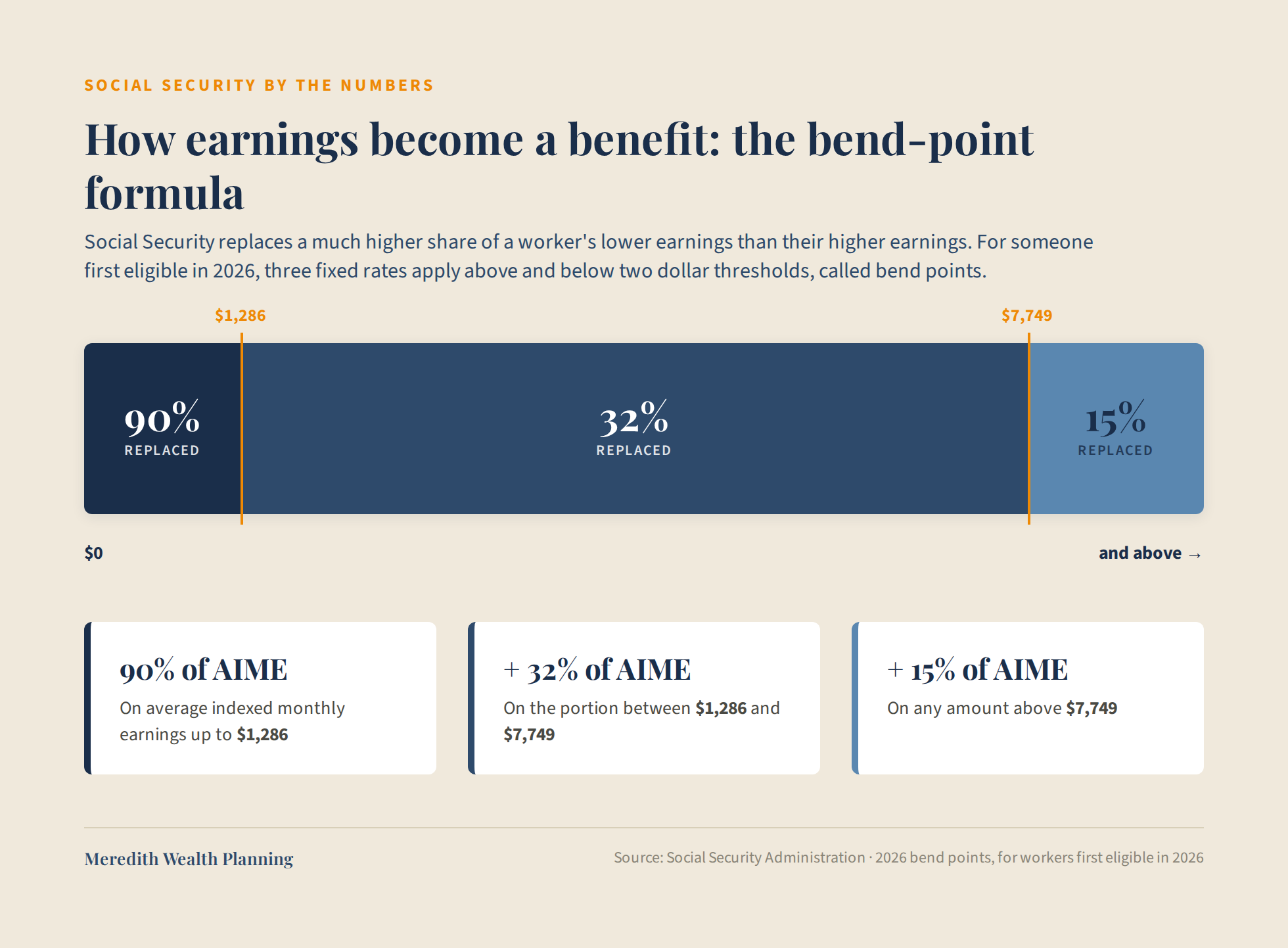
While not all income paid into Social Security counts the same, it all counts, and it currently works on a progressive redistributive structure. Social Security uses a 90/32/15 framework for applying your average indexed monthly earnings (AIME) to your benefits. The first $1,286 of your AIME gets you the most bang for your buck.
Two-earner households that pay in the most get the worst return on their investment. Below you will see the data from a 2025 Actuarial Note from the Social Security Administration. The ratio in the right hand column shows how much you are projected to get back for every $1 you pay into Social Security. This assumes no automatic benefit cut.
A two-earner couple born in 2004 that falls into the low earnings level category could expect $1.69 returned to them for every $1 paid in. A two-earner couple born in the same year that fell into the maximum earnings level category could expect $0.69 returned to them for every $1 paid in.
.png)
Before we get to what I will think will happen, there is a myth floating around worth clearing up. Over the years I have heard quite a bit that Congress or a past President borrowed money from the Social Security Fund and never returned it. Let's look at what the law requires.
Since 1939, any Social Security surplus has been required by statute to be invested in special issue Treasury securities. It was written into the program's design from day 1.
When the Treasury issues securities, the cash they take in from them flows into the government's general fund and is spent on government operations just like cash from any other Treasury bond sale to any other buyer. The Social Security Trust holds IOUs from the federal government and those IOUs have always been honored. They have never defaulted on their IOUs.
If you buy a money market fund or a Treasury bill in your brokerage account, it does not mean the government raided your brokerage account to fund their operations. You have an IOU from the government.
When we run retirement projections for clients at Meredith Wealth Planning we do not build into it the potential of the 22% automatic Social Security cut 6-7 years from now. Why not? I find it very far fetched that they will let that happen.
As mentioned earlier in the post there are a number of potential levers that can be pulled to close the gap, and more than likely I think you will see a combination of various levers pulled, some which might hurt more than others.
My suspicion is that we will see some combination of COLA adjustments, payroll tax increases, and means testing for high earning retirees. It's not a great situation, which could have been rectified in a much more cost effective way if our elected officials would have acted sooner rather than later, but I don't think doomsday is around the corner.
When running financial planning projections I think it would be wise to factor in a lower COLA from Social Security, as well as a higher payroll tax rate in the future for your working years.
You will hear lots of fear mongering about this issue between now and 2032, and I am certain it will be the ultimate political spat when the time comes. It is unlikely they will do anything before they have to. No matter which lever a politician suggests pulling, their political opponent will certainly use it as an opportunity to frame how horrible of an idea it is.
Ultimately it is outside of our control, but I am confident those Social Security checks will keep being sent out for many decades into the future.
This post is for informational and educational purposes only and should not be construed as personalized financial, tax, or legal advice. The projections, dates, and percentages referenced above come from the Social Security Administration and other cited public sources and are subject to change as new Trustees Reports are issued or as legislation is enacted. Meredith Wealth Planning does not control, and cannot guarantee, future action by Congress regarding Social Security's funding, benefit levels, or eligibility rules. Any opinions expressed, including expectations about how a shortfall might ultimately be addressed, reflect the author's own views as of the publication date and not a specific recommendation for any individual's retirement plan. Speak with a qualified financial advisor before making decisions based on Social Security's projected timeline or funding status.
A quick chat to get to know each other and learn more about what you're looking for in an advisor
We know that working with an advisor is a big decision, take some time & sleep on it
When you're ready, we get started with our planning process


.png)


