Dave Ramsey has done a world of good throughout his career, steering potentially millions of people out of a lifestyle of debt and into a lifestyle of savings. The Dave Ramsey show plays weekly across 600+ radio stations, and is estimated to have over 18 million listeners. Many people are in a better financial position today because they took actionable steps from Dave Ramsey's advice.
Much like other nationally known financial gurus, Ramsey's hubris can be a problem at times. In recent years he has repeatedly given baffling advice regarding safe withdrawal rates in retirement.
In the clip below (from November 2, 2023), Ramsey takes a call from "Jay" in Kansas City on this topic and pulls no punches while discussing studies on safe retirement withdrawal rates.
The call starts around the 1:13:48 mark and ends around the 1:22:00 mark. Ramsey suggests one can safely pull 8% per year from their investment accounts in retirement, since the market earns 11.8% and "good mutual funds" should get you 12%. He suggests those doing the studies regarding safe withdrawal rates are just nerds in their mom's basements with no money, while also throwing his own employee under the bus in the discussion.
Let's review Ramsey's advice and what the evidence really shows.
From 01/01/1926 - 06/30/2026 the S&P 500 Index (Source: DFA Returns Web Program) has earned 10.54% annualized, not quite the 11.8% suggested by Ramsey, but hey close enough, right? $1 million invested for 30 years at 11.8% grows to $28,395,799, but at a 10.54% growth rate you're looking at $20,210,813, just a cool $8 million+ difference.
It could be that Ramsey is evaluating a different period. For example, from 1978 - 2025, the S&P 500 actually earned 12.2% a year! Surely, his advice would have been golden during a period like that right?
Here's the thing, even though the market earned 12.2% a year during that period, imagine you retired in 1977 with $1 million (a TON of money at the time) and pulled out $80k a year adjusted for inflation, you would have been broke by 1995.
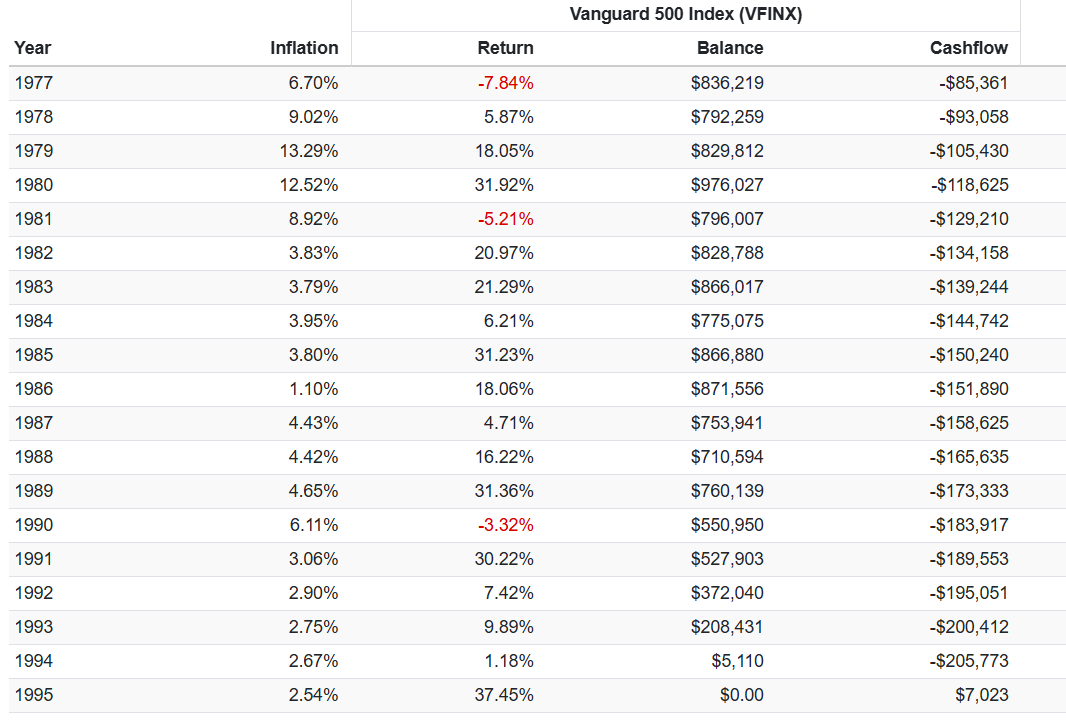
Remember, that was an extremely favorable period of market history, even though the investor went broke by 1995 the Vanguard 500 Index compounded at 13.71% a year from 1977 - 1995. Are we starting to see the problem with Ramsey's recommendation?
.png)
Imagine you retire in a not so favorable market environment, like the period like 2000 - 2019, where the market only earned 6.10% a year. Ramsey suggested you'd get 12% every year. You won't.
Instead of cherry picking different start and end dates, let's look at all 10 year rolling periods. From 01/1926 - 06/2026 there have been 1,087 10-year rolling periods. 492 of them were above 12% a year, while 595 were less than that. Even worse, 53 of the rolling 10-year periods actually had a return less than 0%!
How long do you think your nest egg will last if you earn less than 0% a year while taking out 8% with inflation adjustments? Further, as we saw above you can have an investment that earns far higher than your withdrawal rate and still go broke. Market volatility can sink your ship.
Ramsey is making the fatal planning assumption I have seen many DIY retirement planners make, by assuming no market volatility and that you get the same steady return each and every year. That would be nice, but that's not how the world works.
If you pull the annual S&P 500 returns from 1926 - 2026, it has never earned exactly 12% in a year. There have only been 5 calendar years where it ended the year with somewhere between an 11% - 13% return.
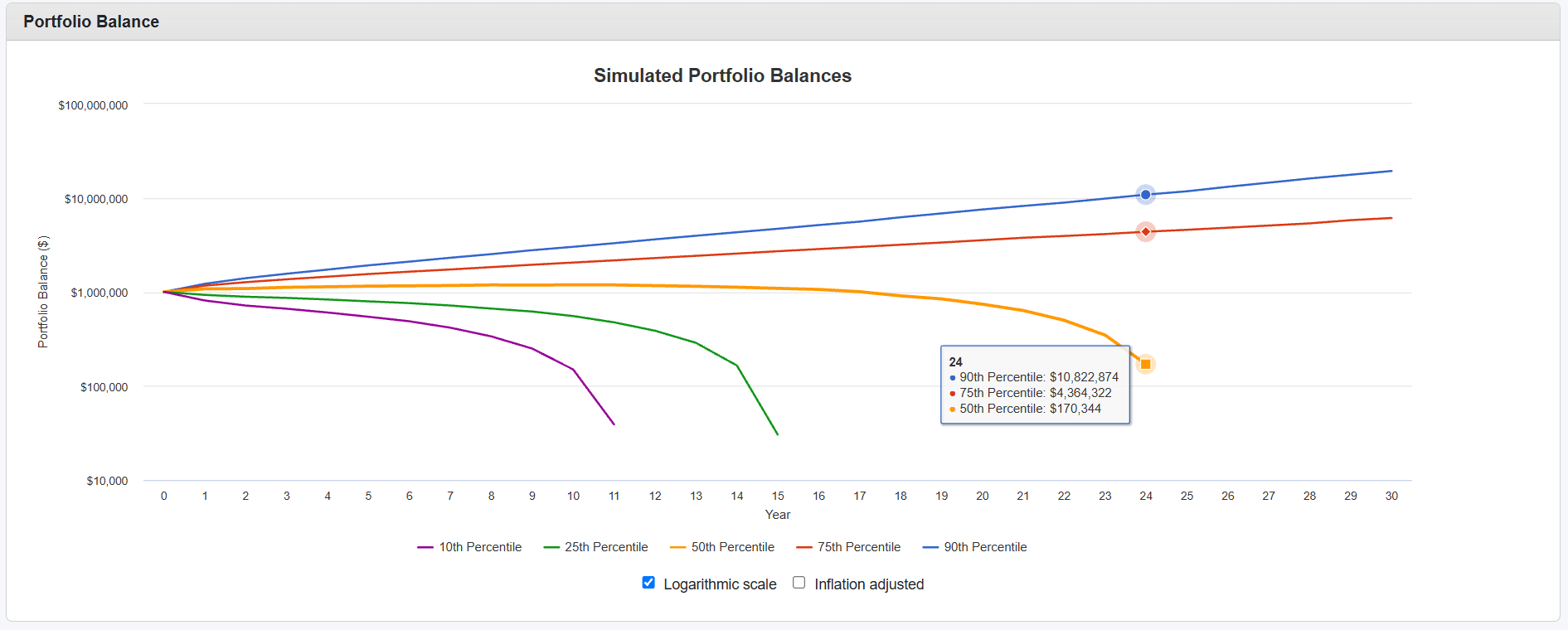
Through www.portfoliovisualizer.com I ran a simulation with their Monte Carlo tool using historical US Stock Market data. I assumed an investor had $1 million and wanted to pull out $6,666 monthly ($80,000 annually) as Ramsey suggests, increased that amount 4% every year for inflation, and would do this for 30 years. Below we see the results:
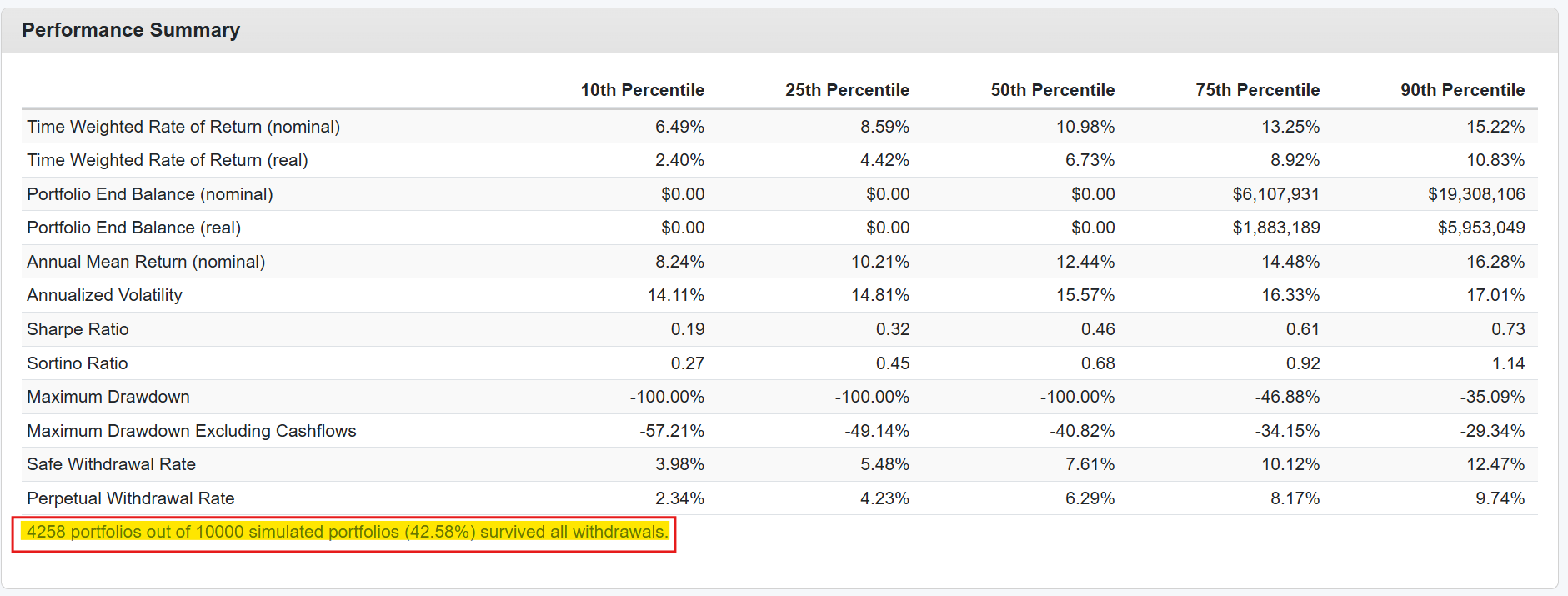
Using historical market returns (which I think are overly generous to forecast going forward) we see only a 42.58% success rate for Ramsey's recommended withdrawal rate. Do you want to retire on a plan that has nearly a 6 out of 10 chance of failure?
On the median outcome from 10,000 simulated portfolios, you're out of money in year 24.
As I throw statistics at you maybe Mr. Ramsey would accuse me of being a nerd in my mom's basement who has never dealt with real money (as he stated in his video), but that is the tactic with these pundits. They say things loudly, confidently, discredit any opposition, while avoiding all potential public debate.
While the "4% withdrawal rate rule" is attacked in the Ramsey clip, one of the smartest minds to every work in the field of finance appears to be a fan of it. Below is a clip from an interview with the legend, Ed Thorp (I have it starting around the 47 minute mark). Ed Thorp is 89 years old in this clip, and you have never heard of him here is a brief background:
Dave Ramsey can help one make a lot of progress on their finances, but after seeing several clips of his like the one I shared above I would steer clear of his retirement withdrawal advice. He does not have any skin in the game for your retirement to be successful. If you're 8% withdrawal rate strategy blows up, it won't be his problem.
Many people have heard of the "4% rule" originated by William Bengen in 1994 (which was attacked in the video). Bengen found that using 30-year rolling periods of actual US Large Cap and US Treasury returns, that a 50% - 75% equity portfolio could sustain a 4% initial withdrawal rate, adjusted for inflation annually. Bengen's original study (1994) had flaws, and over time he has revised it numerous times to add more asset classes (like small cap equities) to the research which has pushed up his estimated safe withdrawal rate closer to 4.7%.
Cooley, Hubbard, and Walz (1998) showed a 75/25 stock-bond portfolio at a 4% annual withdrawal rate had a 98% historical success rate.
Jonathan Guyton and William Klinger (2006) showed safe withdrawal rates can be closer to 6% if the client is willing to accept flexibility to their withdrawals in down market environments.
Anarkulova, Cederburg, and O'Doherty (2022) published the most rigorous study every done on the subject, using a 2,500 country-year dataset spanning 38 developed markets from 1890 - 2019, using a block-bootstrap approach. They found a 65 year old couple willing to accept a 5% probability of failure can sustainably withdraw only 2.26% of their initial balance. Their critique is that the prior research uses too narrow and too favorable of a return history.
Ultimately US equities have been an outlier, in a good sense, so any safe withdrawal rate study only evaluating US equities while ignoring the rest of the world will show skewed results. Retiring with 100% of your money in Japanese equities in 1990 produces a much different safe withdrawal rate than the investor with 100% in US equities during the same period.
Morningstar routinely publishes estimated forward looking safe withdrawal rates using capital market assumptions. Their most recent research estimates it to be 3.9%.
Of course, nothing that precise can be forecasted in advance with the variables involved. Ideally a retiree would start with what they need in terms of withdrawals, and hopefully it is far less than 8% since the probability of failure would be so high.
Ultimately, no research that I have found supports Ramsey's recommended withdrawal rate. He has a big platform with millions of followers, and his words are quite powerful, so my hope is that he is more careful with this type of advice going forward.
Disclaimer: The information presented in this article is for educational and informational purposes only and should not be construed as personalized investment, tax, or retirement planning advice. Market return data was sourced from DFA Returns Web and simulation results from PortfolioVisualizer.com; while believed to be reliable, accuracy is not guaranteed, and neither source is affiliated with Meredith Wealth Planning. Past performance, including all historical index returns, rolling-period statistics, and Monte Carlo simulation results referenced above, is not indicative of future results. Monte Carlo and other simulations are hypothetical in nature, rely on historical or assumed data, and do not reflect actual investment outcomes, fees, or taxes — actual results will vary, and no simulation can guarantee that any withdrawal strategy will or will not succeed. References to safe withdrawal rate research (Bengen, Cooley/Hubbard/Walz, Guyton/Klinger, Anarkulova/Cederburg/O'Doherty, Morningstar, and others) reflect published studies summarized for discussion purposes and should not be interpreted as a recommendation to adopt any specific withdrawal rate. Commentary regarding Dave Ramsey or his published statements reflects the author's own opinion and analysis of publicly available information and is not intended as a personal attack or a comprehensive evaluation of his overall body of work. Every individual's financial situation is different; an appropriate withdrawal strategy depends on factors such as portfolio composition, time horizon, spending flexibility, tax situation, and risk tolerance. You should consult with a qualified, fee-only fiduciary financial advisor before making any retirement income decisions. Meredith Wealth Planning is an SEC-registered investment adviser; registration does not imply a certain level of skill or training. This article does not constitute an offer to sell or a solicitation of an offer to buy any security.
A quick chat to get to know each other and learn more about what you're looking for in an advisor
We know that working with an advisor is a big decision, take some time & sleep on it
When you're ready, we get started with our planning process


.png)


